
100% is a useful benchmark. It isn’t a funding strategy.
Your Body Corporate has R1.6 million sitting in its Reserve Fund.
That sounds reassuring.
Then somebody asks a slightly more awkward question:
R1.6 million for what?
The lift? Painting? Waterproofing? The roof? The gate motors? The next round of redecoration?
That is where things get interesting.
A Reserve Fund balance doesn’t tell the whole story
A 10-year Maintenance, Repair and Replacement Plan isn’t just a list of things that might need money one day.
Every Component is somewhere in its maintenance cycle.
Suppose a lift is expected to cost R925,000 to replace or substantially refurbish and is 26 years into a 32-year cycle. A useful way of looking at the position today is to recognise how much of that future obligation has already accrued.
In the example from an actual OBC plan, that produces an accrued estimated cost of R751,563 for the lift.
Do the same exercise for every Component and suddenly the Reserve Fund has context.
OBC does this at Component level and then rolls the figures up into the relevant Major Capital Items (MCIs). The result is something an accountant, auditor and trustees can actually interrogate.
And sometimes the answer isn’t particularly comfortable
Take the sample figures in the accompanying Accountant & Auditor report.
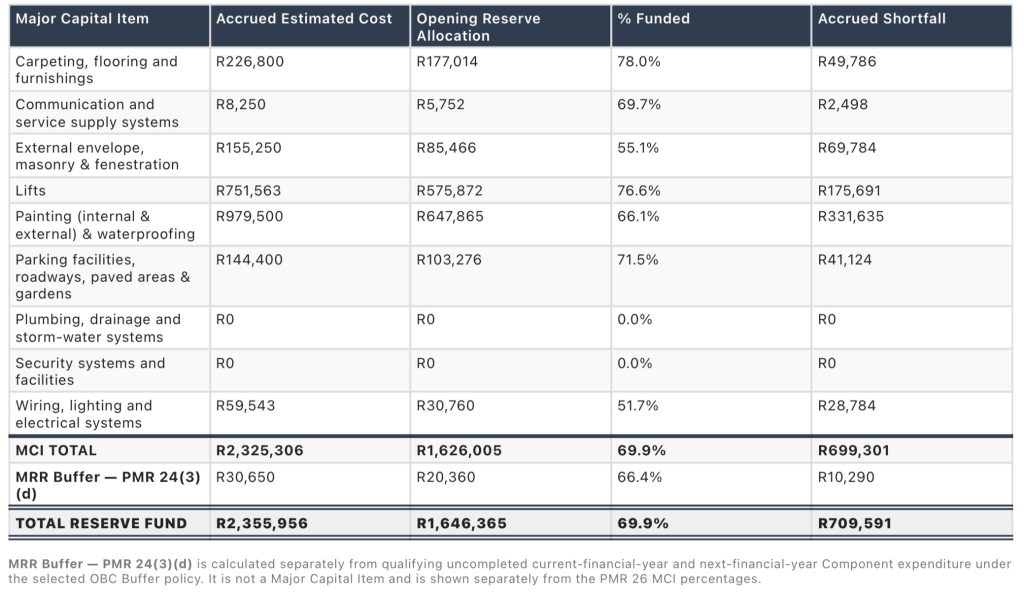
The accrued estimated cost across the Major Capital Items is R2,325,306.
The opening Reserve Fund allocated against those requirements is R1,626,005.
That’s 69.9% funded, with an accrued shortfall of R699,301.
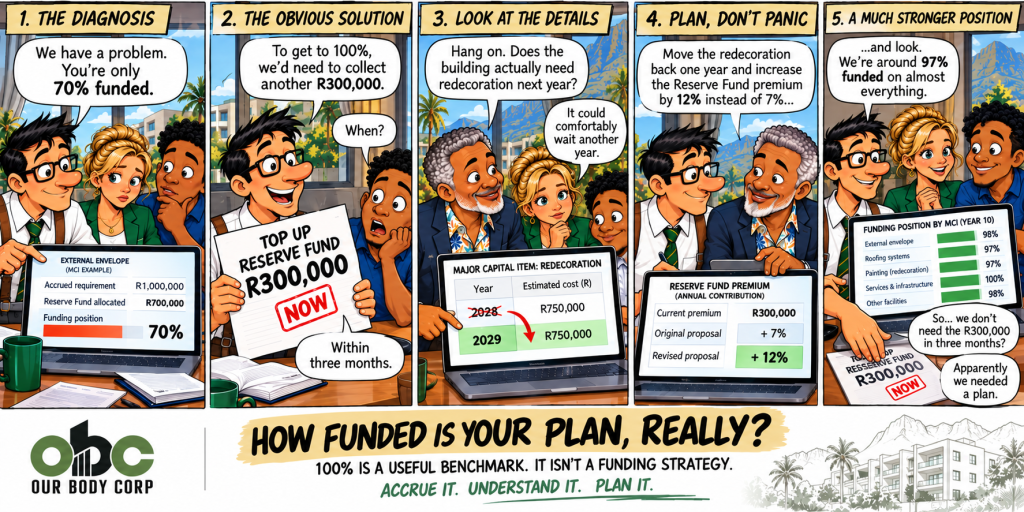
This is probably where Allan would say: “We’re only 70% funded. Find the other 30%!”
That would certainly make the spreadsheet
If the accrued requirement is R2.3 million and you’ve only allocated R1.6 million, one solution is:
“Collect another R700,000.”
It might not be the most practical solution, especially is the funds are required within three months and the members don’t have them.
Preferably within three months.
But what if some of that planned maintenance isn’t really due for another three, five or eight years?
What if an item scheduled for next year is inspected and can legitimately be moved back a year?
What if increasing annual Reserve Fund premiums by 12% rather than 7% substantially improves the funding position over the next few years?
That’s the distinction between measuring the position and planning what to do about it.
100% tells us something useful
Being 100% funded against accrued estimated costs is certainly a useful benchmark.
If a Component has consumed 75% of its maintenance cycle and we’ve accumulated roughly 75% of its estimated cost, that’s a reassuring position.
But the calculation isn’t an instruction to immediately collect every rand of every accrued shortfall.
Consider the actual redecoration example in the report.
Redecoration is estimated at R1.2 million. It is six years through an eight-year cycle, producing an accrued estimated cost of R979,500. That’s useful information, but what if we made the cycle or even and the redecoration could wait that long?
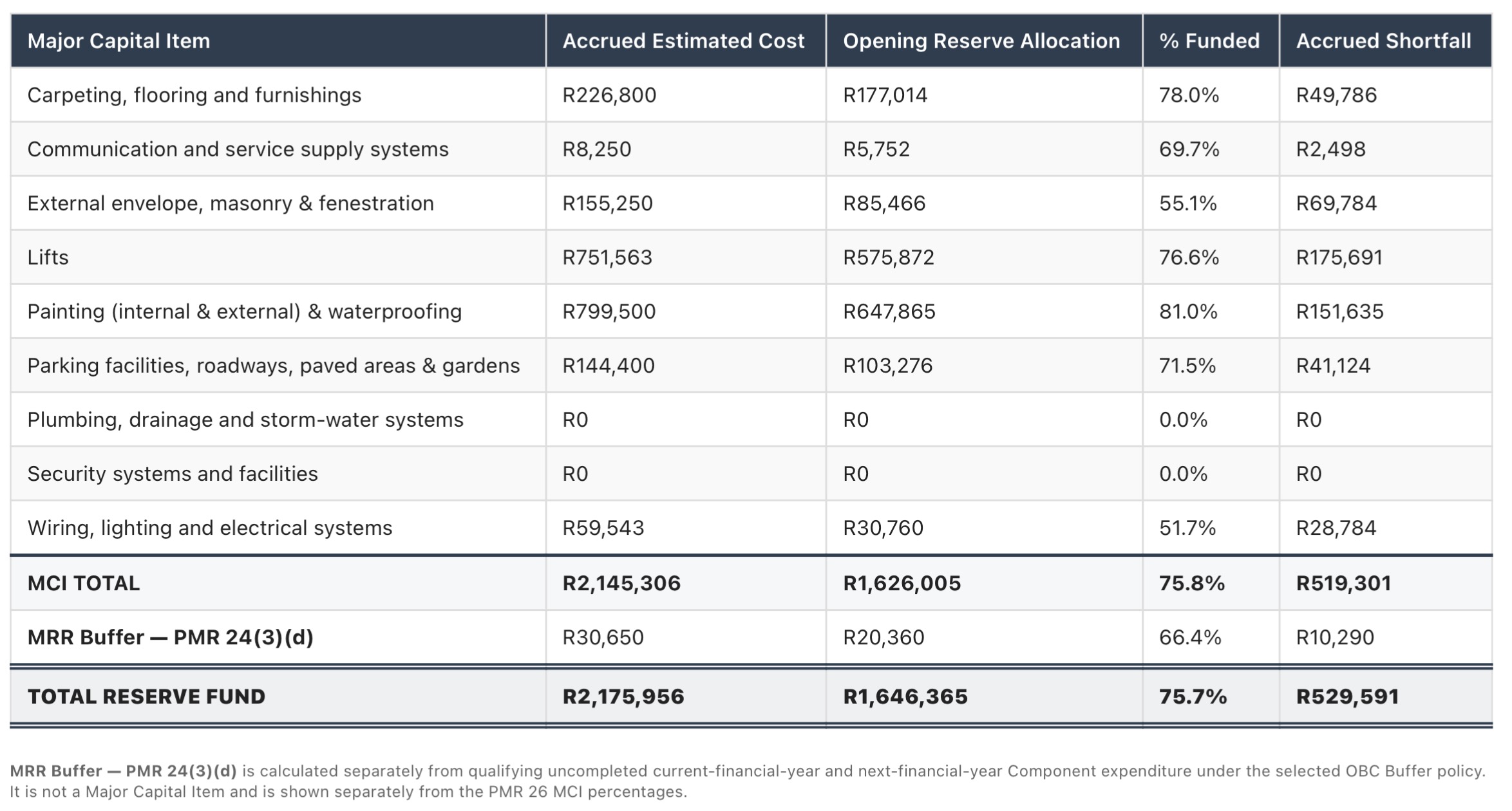
We could essentially bring the accrued amount down to R799,500 and from 66% funded to 81% funded.
If a proper inspection shows that the work can responsibly happen in 2030 rather than 2029, that additional year matters.
It doesn’t make the accrued obligation disappear. It changes the time available to fund it.
And that is precisely what a 10-year plan is for.
Accrual tells us where we are. Cash flow tells us whether the plan works.
Those are related questions, but they aren’t the same question.
The accrued funding schedule asks:
How much of our existing Reserve Fund can reasonably be associated with maintenance obligations that have already accrued?
The 10-year forecast asks:
Starting from where we actually are today, will our Reserve Fund premiums, investment income and existing balances give us enough money when each MRR item actually falls due?
That’s why an MRR Plan shouldn’t be reduced to a single percentage.
In the example report, individual MCI funding positions range from 51.7% for wiring, lighting and electrical systems to 78.0% for carpeting, flooring and furnishings. Painting and waterproofing sits at 66.1%, while lifts are at 76.6%. We moved the Painting and waterproofing out by a year and got it to 81% funded, and the question is do we need to raise more, to get to the 100% of accrued expenses, or can be play with other items?
That is far more informative than simply saying:
“The Reserve Fund has R1.6 million in it.”
But even those percentages are the beginning of the conversation, not the end.
So what should the accountant do?
This is where accountants and auditors can add enormous value without becoming building inspectors.
Don’t simply ask:
“Is it 100% funded?”
Ask:
“Why isn’t it 100% funded — and does the plan adequately deal with the difference?”
Perhaps a Component’s timing needs to be reconsidered.
Perhaps the cost estimate needs updating.
Perhaps the annual Reserve Fund premium needs to increase.
Perhaps expenditure is looming much sooner than everyone realised.
Or perhaps the Body Corporate has a perfectly credible path from a 70% accrued position today to having the money available when the work is actually required.
Those are very different situations.
And don’t forget the money that isn’t neatly attributable to one Component
OBC also identifies the MRR Buffer separately rather than pretending every rand in the Reserve Fund belongs to a specific Component.
That’s deliberate. The Accountant & Auditor notes explain that the Buffer provides a visible allowance for qualifying MRR requirements under the adopted Plan and avoids allocating every rand of the Reserve Fund artificially to identified Components.
Again, the objective isn’t to manufacture a beautiful 100%.
It’s to explain the Reserve Fund honestly.
Give your accountant the plan before the accounts are finished
Perhaps that’s the most practical point of all.
This analysis isn’t terribly useful if the accountant first sees the MRR Plan after the annual financial statements have already been completed.
The OBC report is specifically designed to go to the accountant and auditor before the annual financial statements are finalised. It shows how the opening Reserve Fund has been allocated against accrued MRR requirements and separately identifies the MRR Buffer.
That gives the accountant the opportunity to ask questions while those questions can still make a difference.
And it gives the trustees something considerably more useful than:
“You have R1.6 million in the bank. Well done.”
They can ask:
What has accrued? What have we funded? What’s coming next? And does our plan get us there?
How funded is your plan, really?